
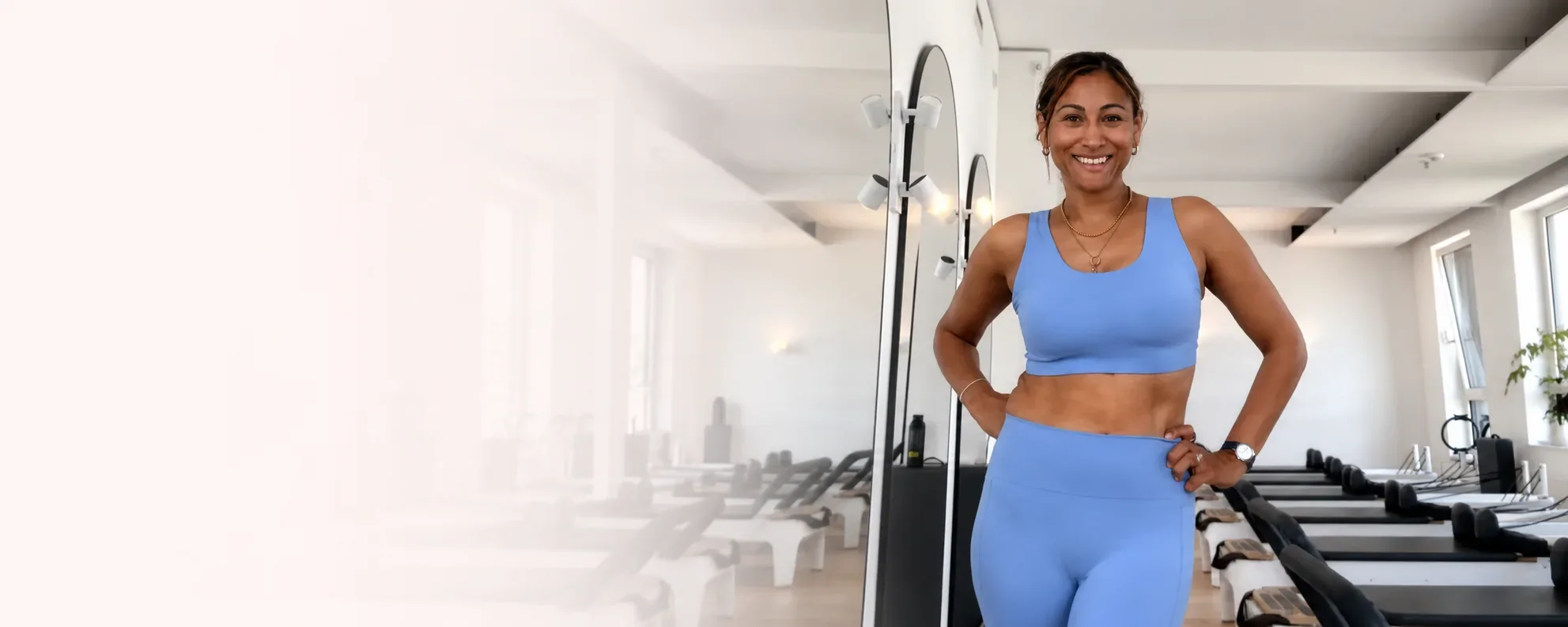

This isn't about earning your dinner
Private Reformer Pilates in Mainz,
plus classes at partner studios in Mainz, Wiesbaden & Frankfurt.
in English or German.
One-on-one sessions, or a class at a studio near you
Built around your body, your joints,
and whatever this week actually looks like,
with the why explained as we go, not just the what.
Find a class near you
Want to try things out? Join one of my beginner classes at one of the great studios I work with
A low-cost, easy way to actually experience Reformer Pilates before committing to anything more. Typically between €15–€30 per class, set by each studio, not by me.
Book and pay directly with them, since they run their own schedules.
Studio owners: I also teach as a guest instructor, in Germany and in South Africa.
22
OCT
Reformer Advanced
18:10
Balance Studio • Mainz
MONDAYS
Reformer • All Levels
07:00
Y7Gym • Mainz-Weisenau
WEDNESDAYS
Full Body Reformer
17:00 & 18:00
Y7Gym • Mainz-Weisenau
30
OCT
Reformer • All Levels
16H00 &
17H00
Y7Gym • Mainz-Weisenau
What is Reformer Pilates?
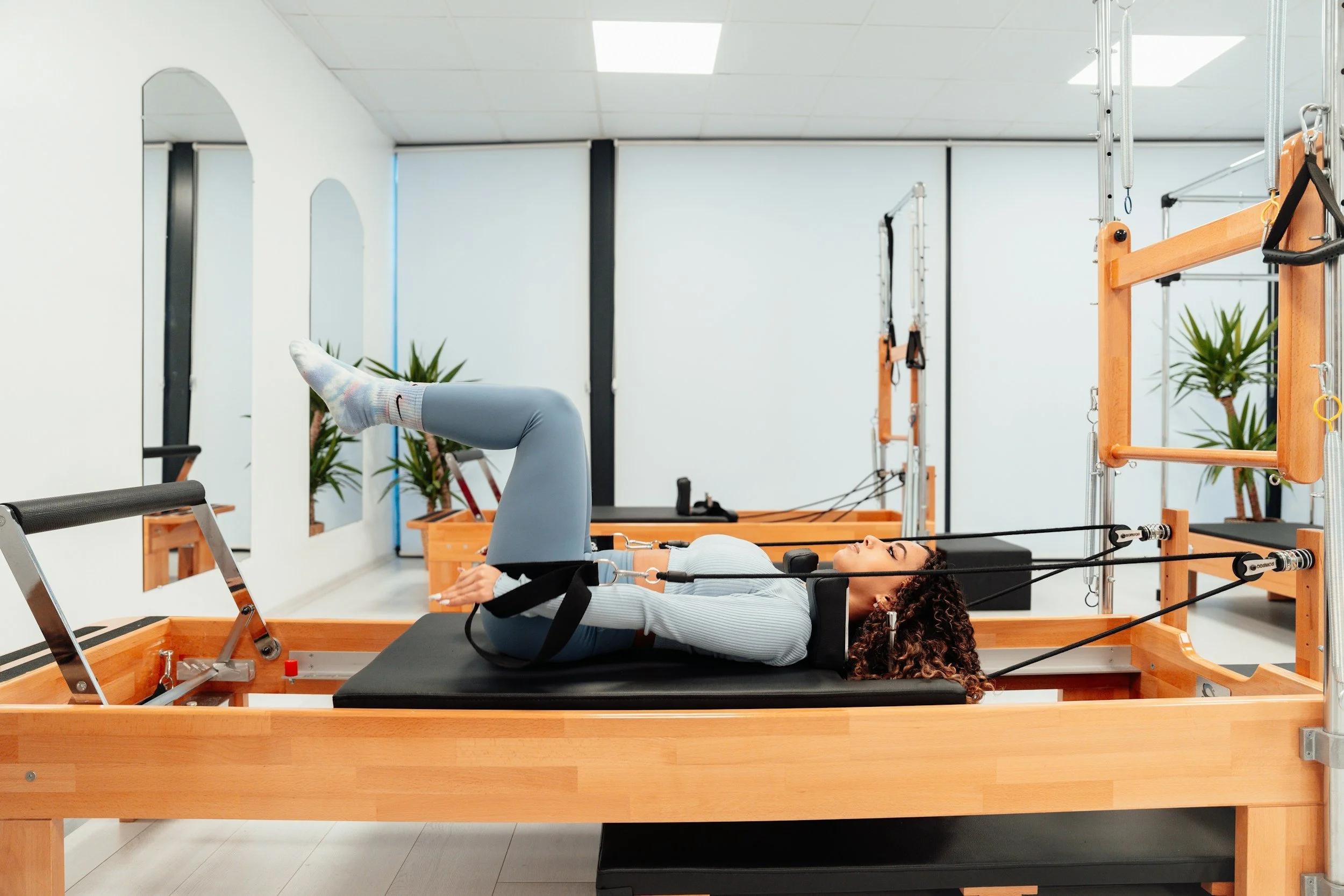
Reformer Pilates is Pilates performed on a machine called a Reformer:
A sliding carriage on rails with adjustable springs that provide resistance. The springs can be set to support a body that needs help or to challenge one that's ready for more, so the same exercise adapts to a painful shoulder or a strong one.
It was developed by Joseph Pilates in the early twentieth century, originally for people who needed rehabilitation. That adjustability is exactly why it suits a body in midlife: real load, precisely dialled, without asking your joints to absorb impact.
Pilates, or Reformer Pilates?
Fair question, and nobody explains it. "Pilates" is the whole method Joseph Pilates created — over 600 exercises across mat work and several pieces of equipment he invented. "Reformer Pilates" means practising specifically on the reformer.
It's one way of doing Pilates, not a separate method.
MAT PILATES
Bodyweight work on the floor. Excellent, portable, and the resistance is limited to whatever your own body provides. Harder to modify if a joint is unhappy.
REFORMER PILATES
Adjustable spring resistance on a moving carriage. The springs can assist or resist, so the exercise adapts to the body rather than the body adapting to the exercise.
Neither is better in the abstract.
If you're managing a joint, coming back after a long gap, or want load without impact,
the reformer gives you more to work with.
If you're nervous about walking in ?
If part of you is worried you'll be the least fit person in the room, the one who doesn't know the moves, the one everyone can tell hasn't done this in years
that worry is normal, and it isn't going to be true in the way you think.
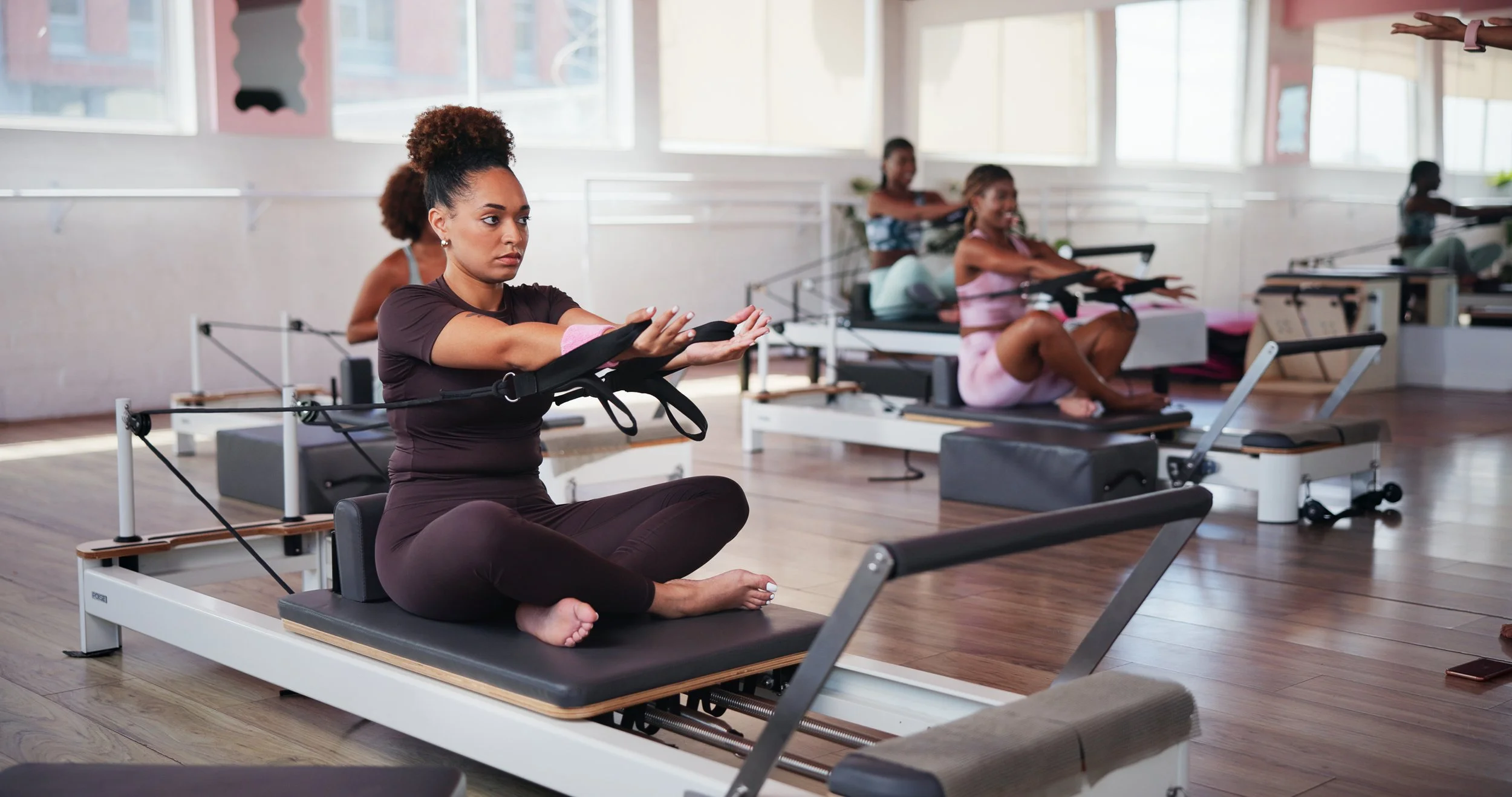
Reformer classes are built around spring resistance, not raw fitness. A genuine beginner and someone five years in can be in the same room, doing the same exercise, at completely different intensities, and nobody watching can tell the difference. You don't need to be flexible, strong, or experienced to start.
You just need to show up once.
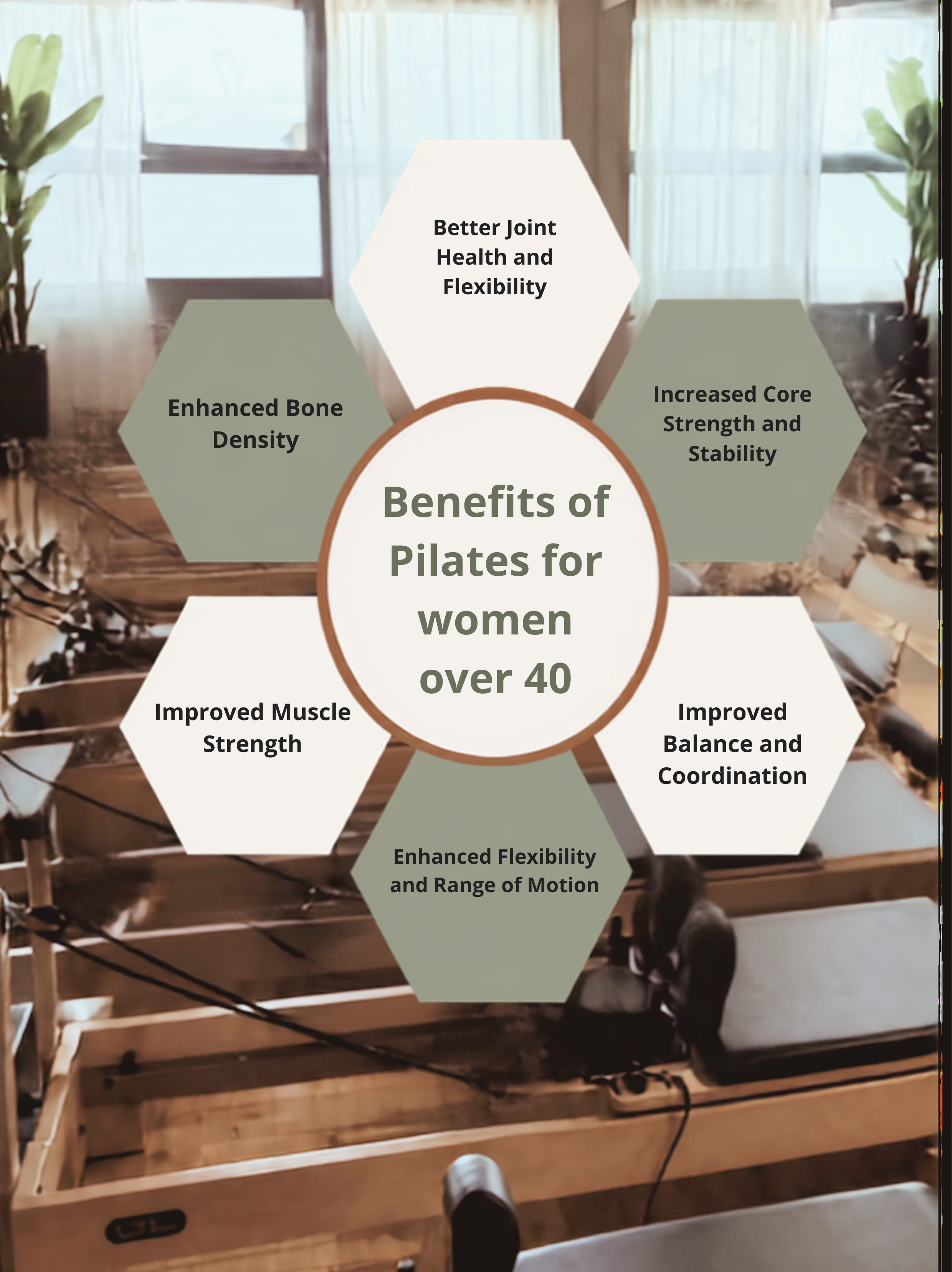
Nobody here is earning their dinner.
Somewhere along the way, "good workout" started meaning "nearly died." If your life already asks enough of you, this hour doesn't need to. Here's the honest, unglamorous version of why the reformer works for a body in midlife — without the drama.
DOES A HARDER WORKOUT ALWAYS MEAN A BETTER ONE?
No, and for a stress-loaded body it can work against you. Punishing, high-intensity exercise pushes the body into a genuine stress response
Cortisol rises, because as far as your nervous system is concerned, you're under threat. That response has its place. But if you're already running on a demanding career, a family, and a body moving through perimenopausal hormonal shifts, stacking another cortisol spike on top isn't building resilience. It's asking an already taxed system to cope with one more stressor. Reformer Pilates is calibrated differently: real resistance, real challenge, without deliberately triggering fight-or-flight.
DOES IT BUILD STRENGTH, OR JUST TONE?
"Tone" is a marketing word. Spring resistance is resistance — it loads muscle, and loaded muscle adapts. After 40 we lose muscle mass steadily, which is biology rather than a personal failing, and the reformer rebuilds strength without throwing heavy weights around or wrecking your joints. Whether it's enough on its own depends what you're training for, and I'll tell you plainly if you'd be better off adding something else.
WHAT ABOUT BONE?
Hormonal shifts in perimenopause change how bones maintain themselves. Controlled, resistance-based movement — footwork, leg work against the springs — is one of the few things that gives a skeleton a reason to stay dense.
WHY DO I FEEL STIFFER THAN I USED TO?
Stiff joints are usually under-moved rather than over-used. The reformer's controlled range of motion — the classic Elephant, the Kneeling Arm Series — opens things back up without the jarring impact of running or jumping. Range of motion narrows with age and a sedentary week, and that narrowing is what turns reaching, twisting and bending into the moments you pull something.
IS "CORE STRENGTH" JUST A BUZZWORD?
Not the way it's trained here. It's the deep stabilising muscles that support your spine and posture through everything else — sitting at a desk all day, lifting your kids, standing through a long meeting. Trained through controlled resistance, not endless crunches. And balance is a skill that fades if it isn't practised: the unglamorous reason you won't be the person who "just fell weirdly" ten years from now.
AND SOMETHING THAT HAS NOTHING TO DO WITH MUSCLE
You cannot check your phone, replay this morning's argument, or draft tomorrow's to-do list while balancing on a moving carriage trying to hold form. That forced presence isn't a side effect — it's part of the point. It's one of the few hours in a busy woman's day where her attention is fully in her own body instead of everywhere else it usually lives.
None of this requires misery.
It requires consistency, and consistency requires a workout you actually want to come back to.
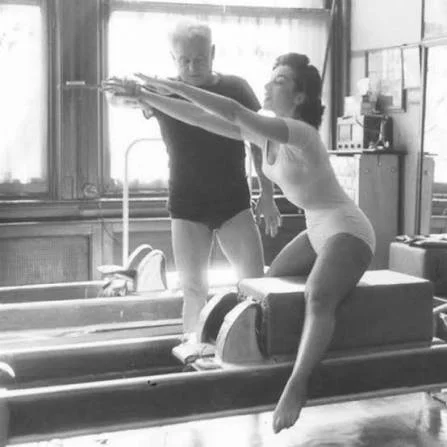
Joseph Pilates was German-born and, during the First World War, interned in England as a German national. In the camp he began developing rehabilitation exercises for fellow internees — rigging springs to hospital beds so injured and bedridden men could still build strength through resistance. He called the method Contrology. That improvised equipment became the direct ancestor of the modern reformer.
In 1926 he and his wife Clara opened their first studio on Eighth Avenue in New York, in the same building as several dance studios. Dancers became early, devoted clients, drawn by how effectively it rehabilitated injury and improved control. He kept developing the method until his death in 1967.
2026 marks a hundred years since that studio opened. The method has outlasted nearly every fitness trend that came after it, for the same reason it worked in an internment camp: it was never built around punishment. It was built to rebuild bodies.
A hundred years of this, and it still works.
What actually makes a session with me different
Qualifications and science explain why Reformer Pilates works.
They don't explain why you'd want to spend an hour with me specifically, so let me just say it directly.
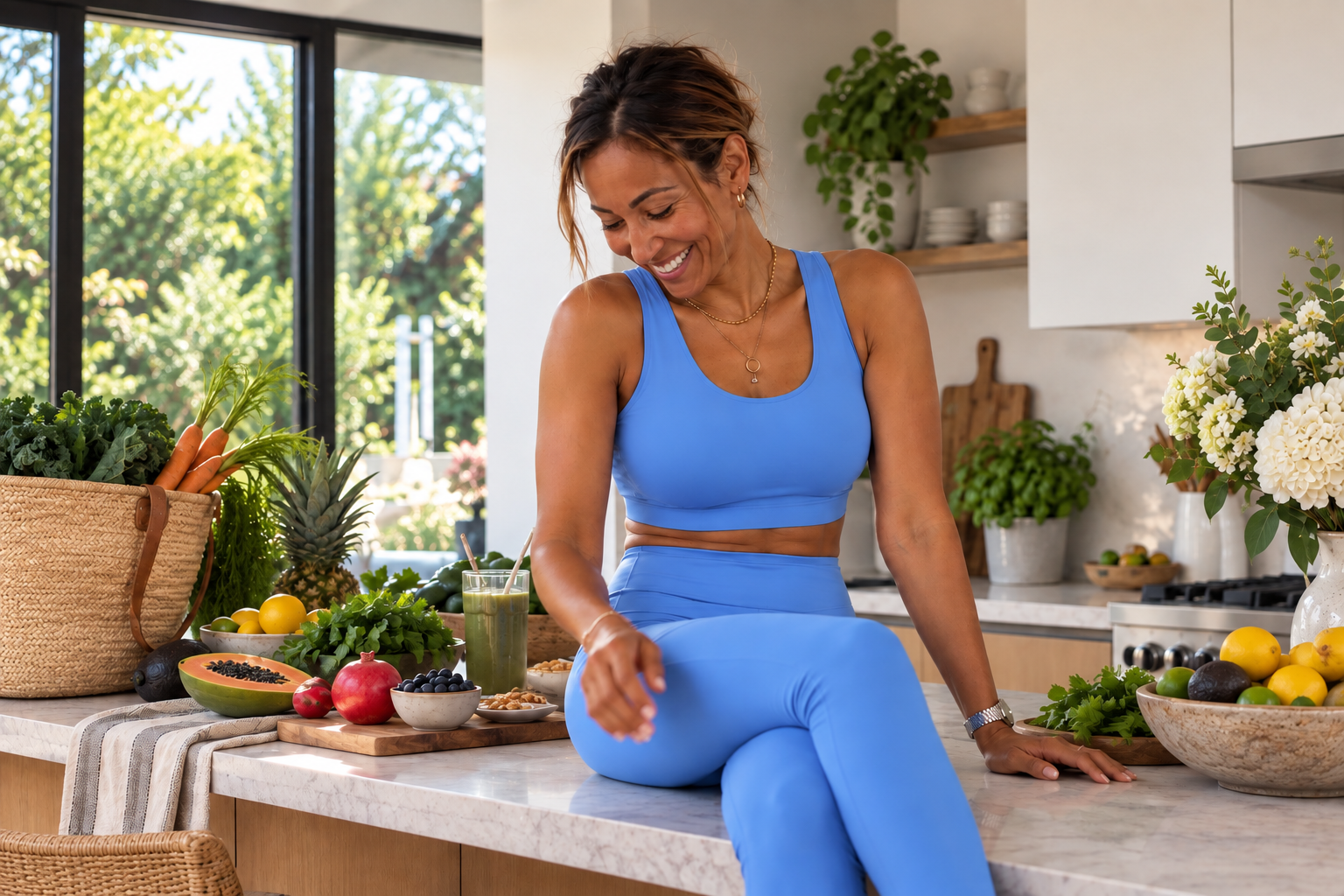
I teach with energy, not just correctness. You'll laugh some. I'm not running a silent, serious studio where the loudest sound is someone's own breathing that's not how I move, and it's not how I teach.
I teach visually, not just verbally. The Q&A above, the infographic, the way I break things down that's genuinely how I explain a movement in the room. If "engage your core" never meant anything concrete to you before, I'll find the version that actually clicks.
And I mean it when I say this hour is yours.
Not homework for your body, not one more thing to optimise.
An hour where the only job is to show up and feel like yourself in your own skin for a while, that's the actual point, and everything else on this page is just the reasoning behind it.
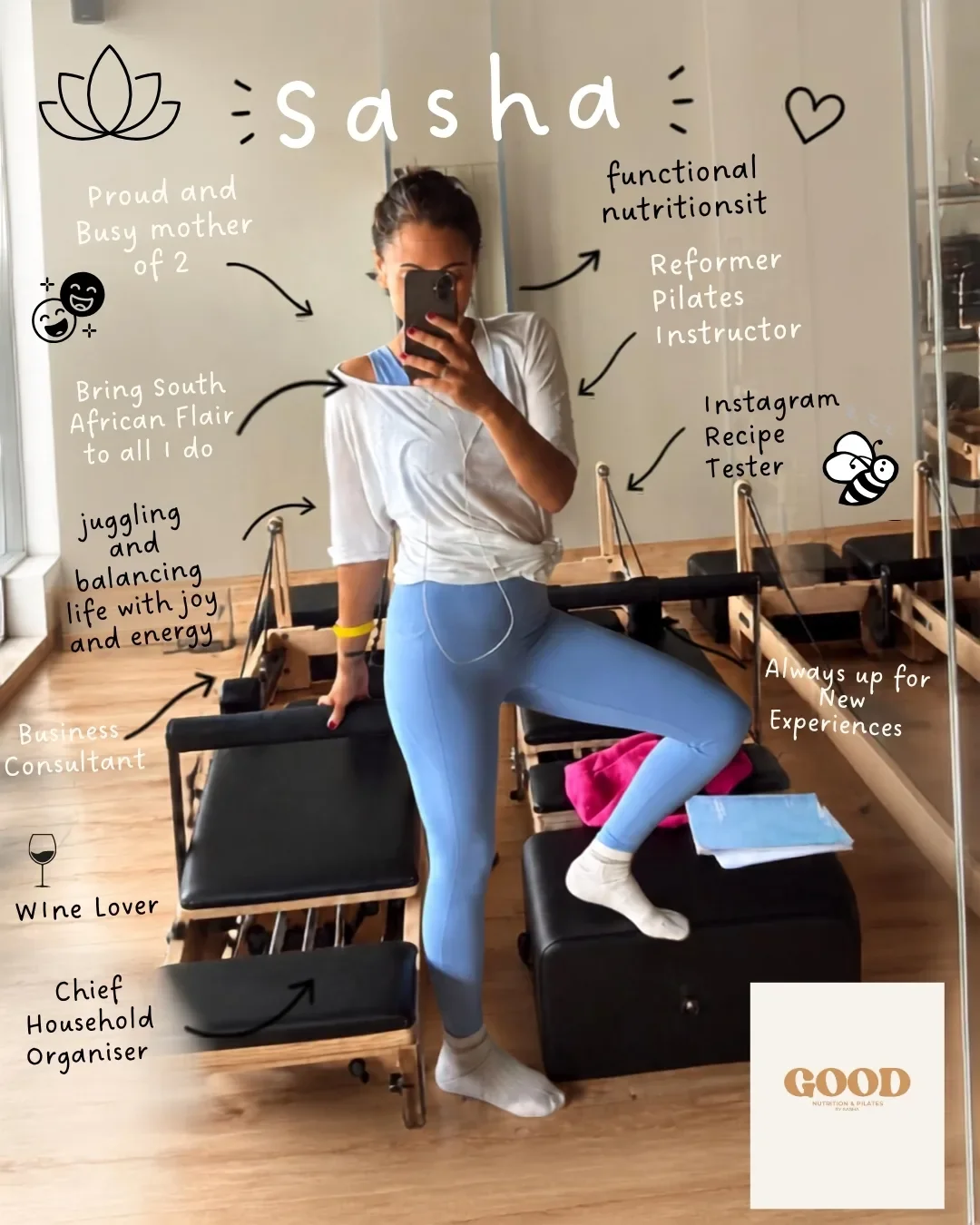
Why I teach this, Specifically.
Nutrition was where I started taking control back, and it worked
My inflammation came down, my labs improved, I stopped feeling like I was fighting my own body every day.
Here's the honest part: nutrition alone got me maybe seventy percent of the way there. I still felt disconnected from my own strength. Still stiff, still tense, still living in my head instead of my body. It wasn't until I put real, intentional, reformer-based movement next to the nutrition work that the actual shift happened.
I chose the reformer specifically, not just movement generally. The springs mean resistance is fully adjustable. The carriage supports your body through the movement, so we can work around a sore joint instead of ignoring it or aggravating it. And the whole method was developed for bodies that needed care, not bodies that needed punishment.
Not addition. Multiplication. That's why I teach both.
Nutrition is the other half of this
What should I expect at my First Reformer Pilates Class?
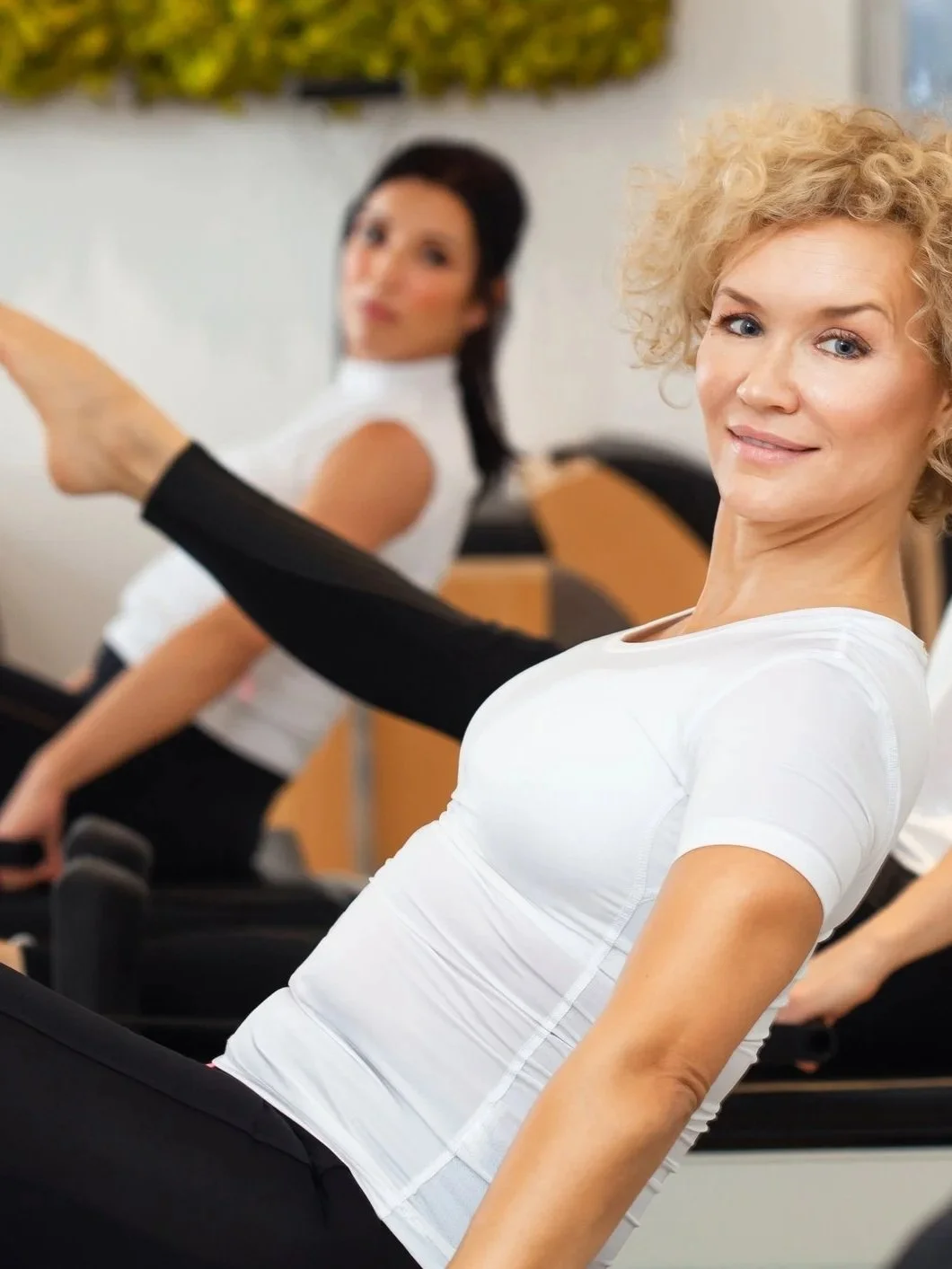
Expect to spend the first ten minutes learning the machine rather than working out. You'll be shown how to lie on the carriage, where your shoulders go, how the springs are set, and how to get in and out of the straps. Wear fitted clothes and grip socks, arrive ten minutes early, and tell the teacher about any injury before the class rather than during it.
You will not know what you're doing, and that's expected. Nobody walks in knowing how a reformer works
Including the people who look like they do.
-
Fitted clothing, nothing that dangles, no zips or buttons, and grip socks. Loose tops flip over your face in some positions and loose trousers catch in the springs. Most studios sell grip socks if you arrive without them.
-
A basic or foundation class, or a stretch class. Not a power class. Class names aren't standardised between studios, so if you're unsure, ring and ask which class a first-timer should come to.
-
Yes, and it's arguably where the reformer matters most — muscle, bone density and balance all need a reason to stay. Joseph Pilates originally built this equipment for people who couldn't get out of bed. If you have osteoporosis or low bone density, say so when you book, because some exercises need adapting.
Everything else nobody tells you free two-page guide
How to lie on the carriage and what a neutral pelvis actually means. Why the springs aren't about heaviness. How to get your feet into the straps without falling over. The difference between basic, stretch, method, advanced and power classes. And the four things nobody warns you about.
Two pages. No jargon. Read it once and you'll walk in knowing more than most people do after three classes.
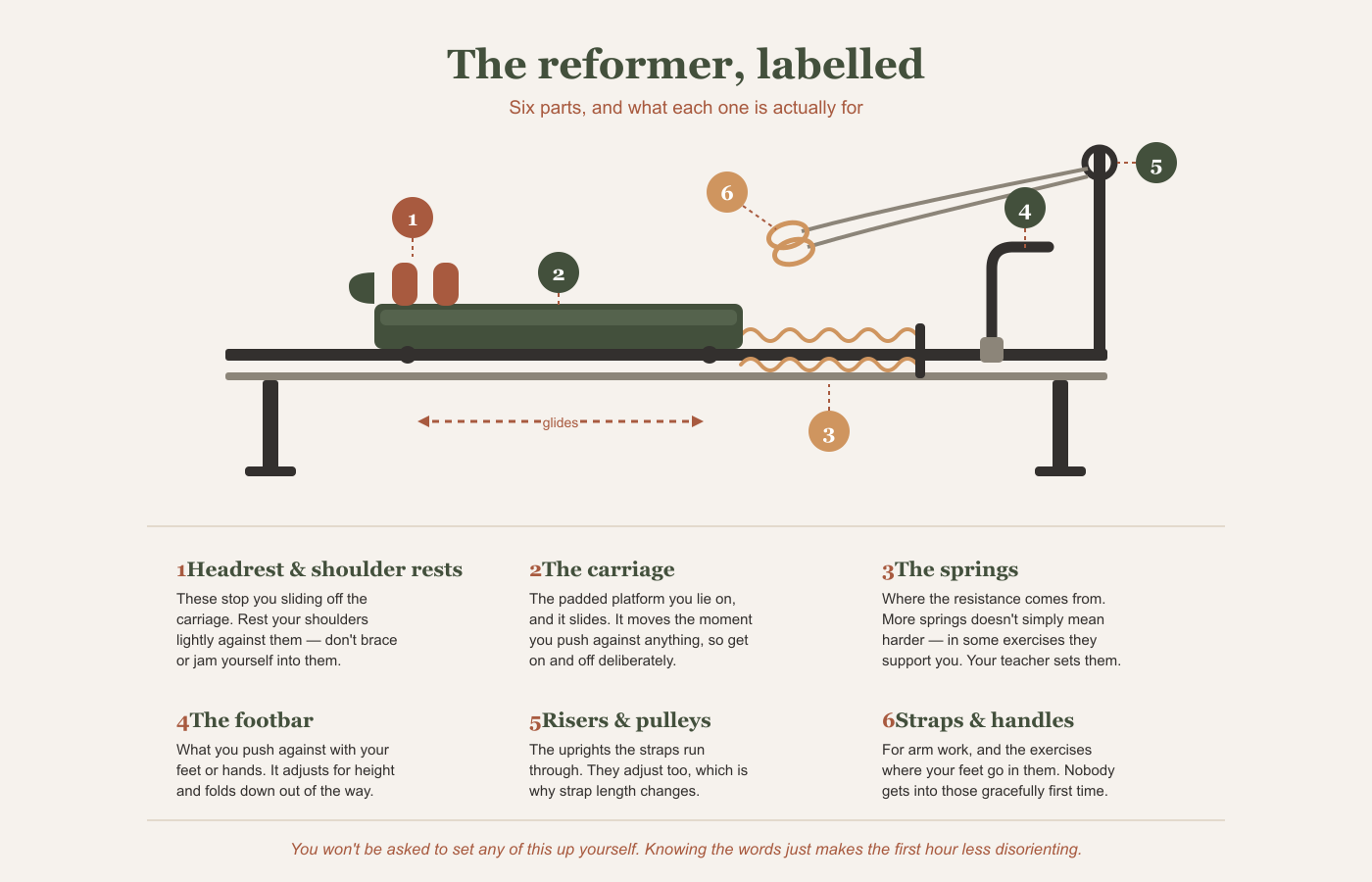
The machine has a handful of parts and they all have names.
Here they are, so the first Ten minutes make sense.
What to actually Expect
Nobody transforms in one session, and I won't pretend otherwise.
Most people notice a real difference in how their body feels
less stiffness, better balance, a sense of actually knowing their own core within the first several sessions. Strength and bone changes take longer and build with consistency, not a single class.
This is a practice, not a quick fix, and that's honestly the point.
Practical questions
-
€70 for 50 minutes, one-to-one, in Mainz. Your first session includes a short intake at no extra cost. Classes at partner studios are typically €15–€25, set and booked by each studio rather than by me.
-
No. Flexibility is an outcome, not an entry requirement, and most people who start with me have never been on a reformer. The springs adjust to the body in front of them.
-
Usually yes, and it's often exactly where the reformer earns its place, because resistance and range can both be dialled down precisely. Tell me what's going on when you book and I'll build the session around it. If something genuinely isn't appropriate, or needs a doctor or physiotherapist first, I'll say so plainly rather than let you find out in the room.
-
Fitted clothing — loose clothes can catch on the springs — and nothing with zips or buttons that dig into the carriage. Grip socks are usually required and most studios sell them if you don't have a pair.
-
Twice a week is where most people start seeing real change, and once a week held consistently for a year beats three times a week for a month. Consistency does more than intensity here.
-
Yes — private sessions in English or German, whichever you prefer. Class language depends on the partner studio; ask me and I'll tell you which run in English.
-
Private sessions in Mainz. Classes at partner studios in Mainz, Wiesbaden and Frankfurt, listed below with booking links to each.
Not sure whether to book a private or find a class?
Never tried it and want to test it free first, watch the at-home video below.
Ready to try it in person, low cost, no commitment
Join a beginner class at one of the studios I work with. Typically €15–€30.
Recovering from an injury, or want sessions built specifically around you
book a private session. €70 for 50 minutes.
Already comfortable and want the movement plus the nutrition conversation come to a
Mini-Retreat: €37.
Want to try it before you try it?
No studio, no booking, no commitment
Just ten minutes to see if this is for you.
This short video walks through reformer-inspired movements you can try on a mat at home, so you know what your body's getting into before you set foot in a studio.
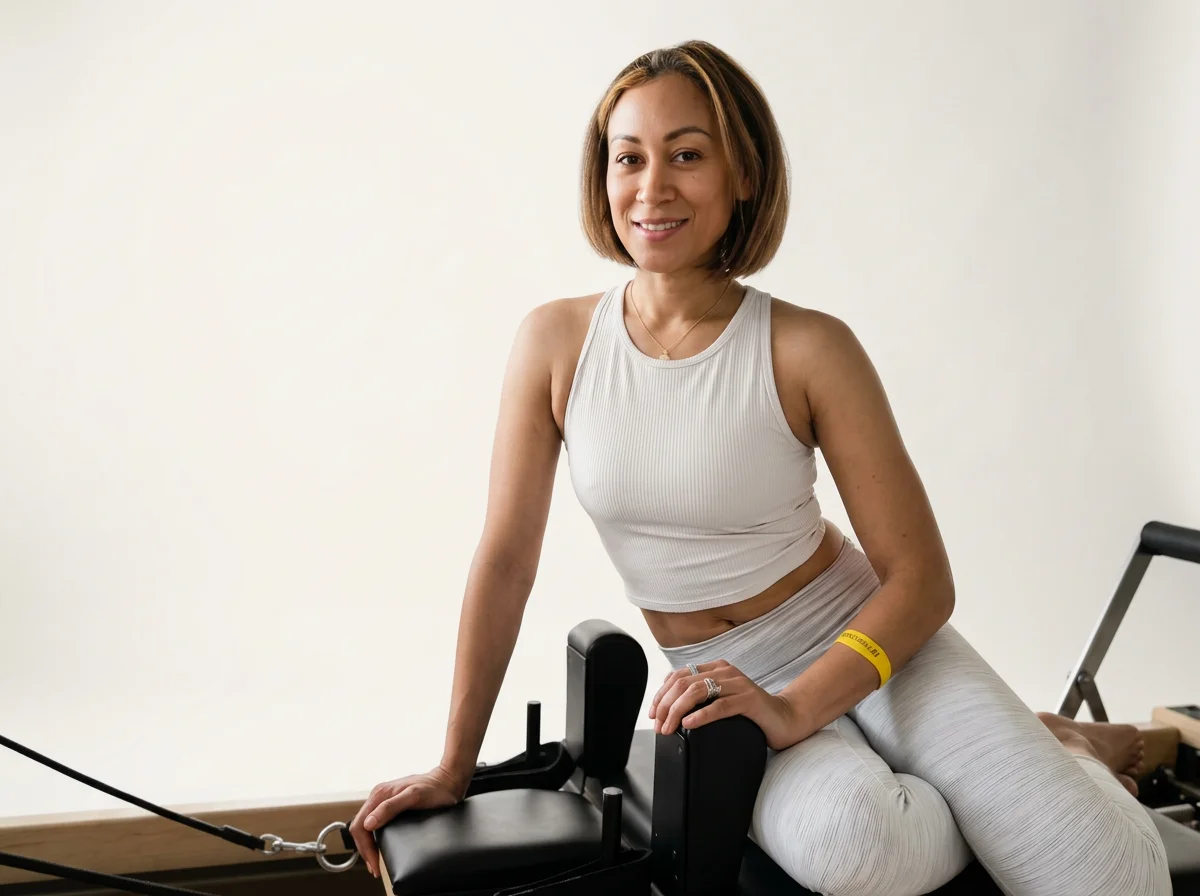
Book a private session using the calendar below.
€70 per 50-minute session, in Mainz.
Your first session includes a short intake so we can build around whatever you're currently dealing with joint issues, energy, or just "where do I even start".
Want the fuller experience?
Private sessions and classes are where the physical work happens.
If you want more than that: 90 minutes, a Reformer session, a proper cool-down, your matcha, and real conversation with women who get it
that's what the Mini-Retreats are for you.